


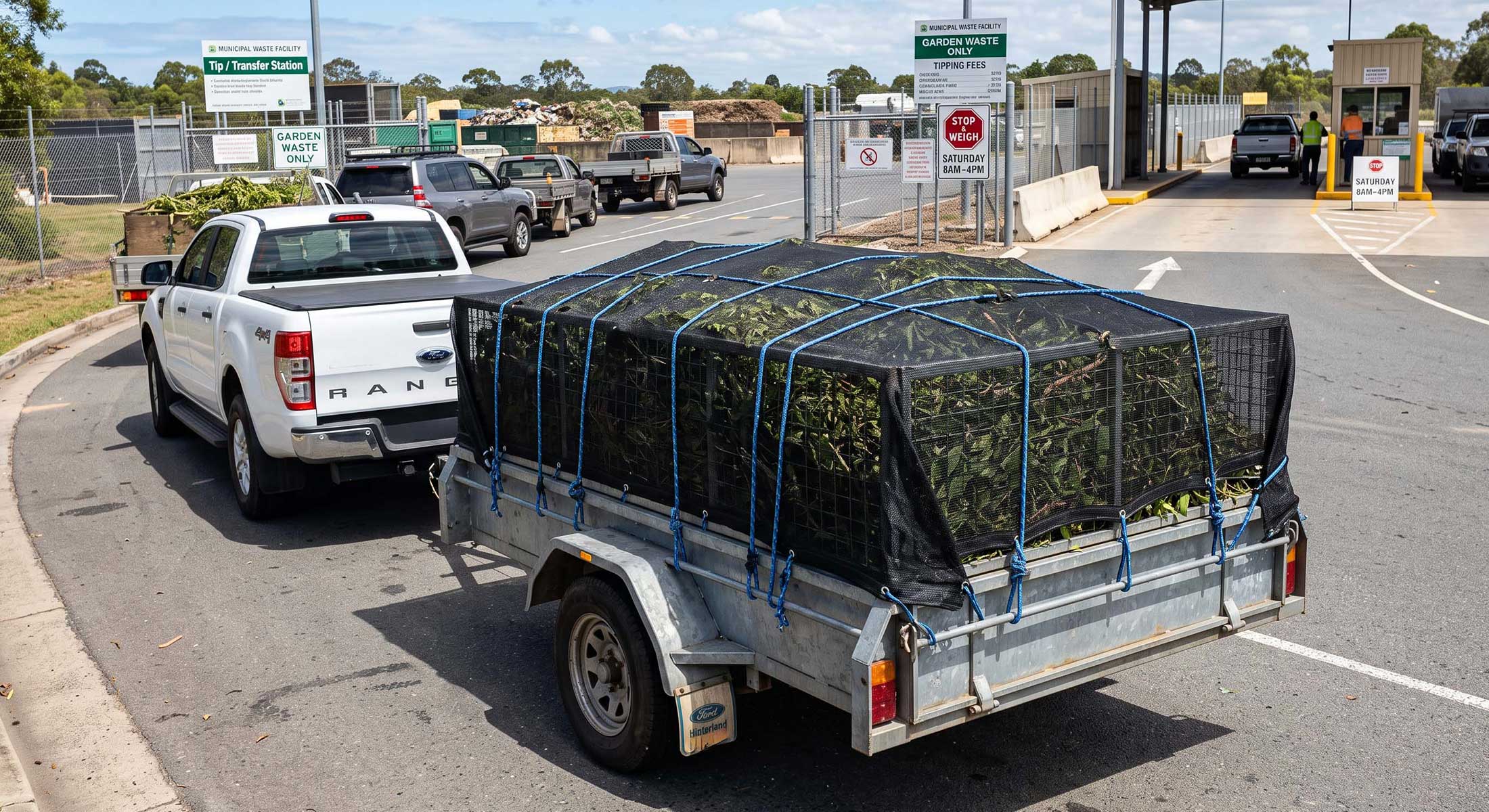
Waste Runs Without the Fines
How to Secure a Load the Smart Way.
There’s a particular kind of dread that comes with glancing in the rear-view mirror on a tip run and watching a plastic bag lift off the top of your load and cartwheel across two lanes of traffic. It’s happened to nearly everyone who’s ever thrown a trailer-load of rubbish, green waste or renovation debris together and hit the road without giving much thought to what’s actually holding it all in place.
The thing is, an uncovered or poorly secured load isn’t just an embarrassing moment on the highway. It’s a genuine legal and safety issue, and one that authorities across Australia take seriously enough to hand out real fines for. The good news is that avoiding all of it — the fly-aways, the littering, the risk of a fine turning up in the mail — comes down to one straightforward fix: properly securing and covering your load before you leave the driveway.
Why an Uncovered Load Is a Bigger Deal Than It Looks
It’s easy to think of a loose tarp corner or a few stray items on top of a load as a minor oversight — something that might look untidy but doesn’t really matter in the scheme of things. In practice, it’s treated very differently by road authorities, and for good reason.
An unsecured load creates genuine hazards for everyone else on the road. Lightweight debris — packaging, offcuts, garden waste, insulation, loose plastic — doesn’t need much wind speed to lift clear of a trailer or ute tray once you’re travelling at highway speed. Once it’s airborne, it becomes a hazard for the vehicles behind you, something that can obstruct vision, cause a following driver to swerve suddenly, or simply end up scattered across the road as litter that someone else now has to deal with.
This is exactly why load restraint isn’t treated as a minor road rule. Across Australian states and territories, driving with an unsecured or overhanging load is a specific offence, separate from general littering laws, and it typically carries a real fine along with demerit points against your licence. On top of that, driving with an uncovered load that results in material blowing off — or in some jurisdictions, simply carrying material that could blow off, regardless of whether it actually does — can also fall under litter legislation, which brings its own separate penalties. Depending on the state and the specific circumstances, penalties for these offences can run into the hundreds of dollars for an individual, with even steeper fines applying to businesses and repeat offenders.
The exact fine amounts and specific rules vary somewhat between states and territories, so it’s always worth checking the current road rules in your own jurisdiction. But the general principle holds everywhere: if you’re on a public road with a load that isn’t properly secured and contained, you’re taking on real legal risk, not just a theoretical one.
The Most Common Ways Loads Go Wrong
Most load-related fines and roadside incidents come down to a handful of recurring mistakes, and recognising them is the first step to avoiding them.
Loose, lightweight material is the most obvious culprit. Green waste, packaging, foam offcuts, loose soil or mulch, and general household junk are all prone to shifting and lifting at speed, particularly on a trailer or open tray with nothing over the top. Even material that seems too heavy to move on a still day behaves very differently once you’re doing 80 or 100 kilometres an hour and catching crosswinds.
A tarp that isn’t properly secured is another common failure point, and often a more dangerous one than no cover at all. A tarp with a corner that’s come loose, or one that’s simply draped over the load without being tied down properly, can work itself free at speed and become a hazard in its own right — flapping violently, obstructing the driver’s vision through the rear window, or coming off entirely and landing on the road behind the vehicle. A poorly secured cover gives a false sense of security while doing very little to actually contain the load underneath.
Overloading beyond what a tarp or restraint system is realistically designed to handle is another issue that catches people out, particularly on a full tip run where the temptation is to squeeze in one more load rather than make a second trip. A cover that’s stretched to its absolute limit, straining at every eyelet, is far more likely to fail than one that’s covering a reasonable, well-distributed load with some margin to spare.
Why Mesh Beats a Solid Cover for This Job
When people think about covering a load, the instinct is often to reach for a solid, fully waterproof tarp. For a lot of applications that’s exactly the right call — but for waste runs and general load securing specifically, a reinforced mesh tarp is very often the smarter choice, and it’s worth understanding why.
A solid tarp works by sealing the load in completely, which is great for keeping rain off but comes with a significant downside for this particular use case: wind resistance. A large solid tarp stretched over a loaded trailer catches wind like a sail. At highway speed, that wind load puts serious strain on every tie-down point, and it’s exactly the kind of pressure that causes eyelets to tear, ropes to work loose, and covers to fail at the worst possible moment.
A mesh tarp solves this by letting air pass straight through the material rather than pushing against a solid surface. This dramatically reduces the wind load the cover experiences, which means less strain on your tie-down points, less flapping and movement at speed, and a cover that’s far less likely to work itself loose over the course of a trip. For containing loose, lightweight waste specifically, this is exactly the property you want — the mesh holds everything in place without turning into an oversized kite the moment you merge onto the highway.
Mesh also does a genuinely better job of containing the specific kind of material that causes littering problems. A fine, tight weave stops loose debris, packaging, light branches and general rubbish from escaping through gaps, while still allowing enough airflow that the cover itself isn’t fighting the wind. For fresh green waste in particular, this ventilation is a bonus rather than a compromise — a sealed cover over damp green waste traps heat and moisture, which speeds up decomposition and makes for an unpleasant, smelly load by the time you reach the tip. Mesh keeps the load ventilated the whole way there.
What to Look for in a Reinforced Mesh Tarp for This Job
Not all mesh is built the same, and for a job that has real legal and safety consequences if it fails, it’s worth choosing a mesh tarp that’s genuinely up to the task rather than the cheapest option available.
Weight and weave density matter considerably. A lightweight, loosely woven mesh might be fine for light garden shade, but for containing a genuine load at highway speed, you want a heavier, more tightly constructed mesh that has real tensile strength and won’t stretch or sag under load. This is where a properly rated cargo mesh tarp — built specifically for load securing rather than general-purpose shade or screening — earns its keep.
Reinforced edges are just as important as the mesh itself. The edges and corners of any load cover take the most strain, since that’s where all the tie-down tension concentrates. A mesh tarp with a genuinely reinforced perimeter — rather than a simple hem — holds up far better under the repeated stress of being tied down, driven with, and untied trip after trip.
Solid attachment points make the practical difference between a cover that goes on quickly and stays put, and one that’s a constant fight to secure properly. Sturdy eyelets, and ideally additional reinforcement like D-rings or webbing at key attachment points, give you a reliable, secure connection for rope, straps or bungees, rather than a weak point that’s likely to be the first thing to fail.
Our range of mesh tarpaulins covers this kind of genuinely load-rated, reinforced construction, built specifically for the demands of securing a real load rather than general light-duty covering.
Getting It Right Before You Leave the Driveway
Beyond choosing the right tarp, a few habits make the difference between a load that’s genuinely secure and one that only looks secure until you hit the first patch of open road.
Distribute the load evenly and keep the overall height reasonable before you even think about covering it. A load piled unevenly or stacked too high is harder to cover properly and puts more strain on the tie-down points regardless of how good the cover itself is.
Cover the full load with adequate overhang on all sides, rather than a cover that just barely reaches the edges. A tarp with generous coverage gives you material to work with at every tie-down point and reduces the chance of gaps where wind can get underneath and start working the cover loose.
Secure every available eyelet or attachment point rather than just the corners. It’s tempting to tie down the four corners and call it done, but a cover with additional tie-down points along the sides and ends distributes wind load far more evenly and is significantly less likely to develop a loose section over the course of a trip.
And check the load again after the first few minutes of driving, particularly on a longer trip. Ropes and straps can settle and loosen slightly once the load starts moving and vibrating, and a quick check early in the journey — pulling over briefly to confirm everything’s still tight — catches problems before they become a genuine hazard further down the road.
A Straightforward Fix for a Genuinely Common Problem
Nobody sets out to litter the highway or risk a fine on a tip run. Most uncovered or poorly secured loads happen because people underestimate just how much wind pressure builds up at speed, or because the tarp they’re using simply isn’t built for the job. Choosing a properly constructed, reinforced mesh tarp and taking a few extra minutes to secure it properly removes almost all of that risk in one straightforward step.
It’s a small investment of time and gear that saves you from a fine, keeps other road users safe, and means your waste actually ends up at the tip instead of scattered along the highway behind you.
Browse the full range of reinforced mesh tarpaulins at Discount Tarpaulins and get your next waste run properly sorted before you hit the road.
