


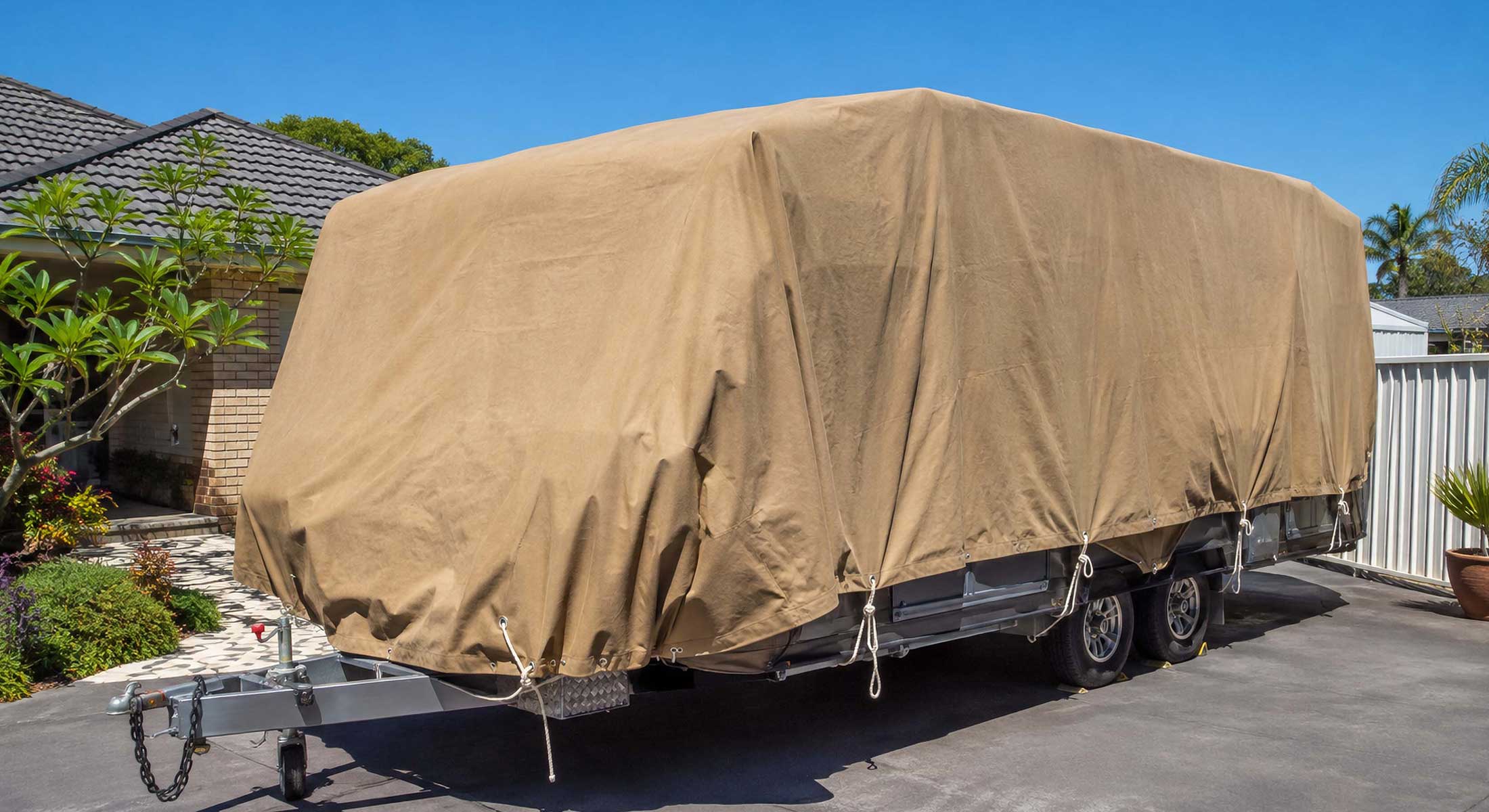
Tarps for Boat and Caravan Covers
Choosing the Right Tarp to Protect Your Investment Between Trips.
There’s a particular kind of anxiety that comes with owning a boat or caravan. Unlike a car, which gets driven regularly and lives in a garage, a boat or van often spends the majority of its life parked in the driveway or a storage yard, exposed to whatever the weather decides to do, for weeks or months between trips. And unlike most things that sit outside, a boat or caravan represents a genuinely significant financial investment — the kind of purchase where a poorly chosen cover isn’t just an inconvenience, it’s a real risk to something that cost tens of thousands of dollars.
The frustrating part is that most people covering a boat or caravan get the material choice wrong without realising it, and the mistake doesn’t show up immediately. It shows up months later as mould on upholstery, a musty smell that won’t shift, or gelcoat and paintwork that’s degraded faster than it should have. The cover looked like it was doing its job the whole time — right up until you pulled it off and found the damage that had been quietly happening underneath.
Why Boats and Caravans Are a Different Storage Problem
Most tarp applications involve covering something for a weekend, a season, or while a specific job gets done. Boat and caravan storage is different because the timeframes are often much longer — many owners cover their boat or van for the majority of the year, with only a handful of trips breaking up long stretches of outdoor storage. That duration changes the calculation considerably.
A cover that performs adequately for a short-term job can fail in ways that only become apparent over months. Trapped condensation that would evaporate harmlessly after a weekend becomes a genuine mould problem after eight weeks sealed against upholstery. UV exposure that a lightweight material shrugs off for a fortnight starts causing real degradation after a full summer. The margin for getting the material choice wrong is much smaller when the cover is doing its job for months at a stretch rather than days.
There’s also the shape problem. Boats and caravans are rarely simple rectangles. Hulls curve, caravans have awnings, roof vents, air conditioning units and various protrusions, and the overall silhouette is often nothing like the flat load a standard tarp is designed to sit over neatly. Getting a cover that actually fits — rather than one that bunches, gaps or catches wind because it’s fighting the shape underneath it — takes more thought than throwing a tarp over a trailer load.
The Breathability Question: Why It Matters So Much Here
If there’s one concept that matters more for boat and caravan covers than almost any other tarp application, it’s breathability — and it’s worth understanding properly before deciding on a material.
Boats and caravans both contain a huge amount of surface area that’s sensitive to trapped moisture. Upholstery, carpet, timber cabinetry, curtains, mattresses, cushions — all of it is vulnerable to mould and mildew if it sits in a humid, poorly ventilated environment for an extended period. And a sealed cover over a boat or caravan, particularly one that traps warm air against these surfaces during the day and lets it condense as temperatures drop overnight, creates exactly that kind of environment if it isn’t managed properly.
This is where the distinction between breathable and non-breathable materials becomes genuinely important, rather than a minor technical detail. A fully sealed, non-breathable cover — like a solid PVC tarp fitted tightly with no ventilation gaps — traps moisture vapour that’s released from the vessel or van itself, as well as ambient humidity, inside the covered space. Over weeks and months, that trapped moisture has nowhere to go, and it ends up condensing on interior surfaces, contributing to exactly the mould and mildew problems that a cover was supposed to prevent.
A breathable cover — canvas being the standout example — allows that moisture vapour to pass through the fabric rather than being trapped. The result is a covered environment that stays measurably drier over an extended storage period, even though the cover itself is still providing genuine protection from direct rain and UV.
This doesn’t mean non-breathable materials are always the wrong choice — there are situations where a sealed PVC cover, used correctly with attention to ventilation, is genuinely the better option, particularly for hull and deck protection on a boat where interior moisture management is handled separately. But it does mean the breathability question needs to be part of the decision from the start, rather than an afterthought.
Poly Tarps for Boats and Caravans: Where They Fit
Poly tarps are the most affordable and readily available option, and for shorter-term or budget-conscious covering needs, they have a genuine place in boat and caravan storage — just not necessarily as the primary long-term solution for the whole vessel or van.
A poly tarp works well as a supplementary cover — protecting a specific vulnerable area like an exposed engine, an uncovered section of deck, or acting as a ground sheet or drip barrier underneath a boat or caravan during storage. For short-term covering between trips, where the gap between uses is measured in days or a couple of weeks rather than months, a poly tarp’s lack of breathability is much less of a practical problem, since there simply isn’t enough time for serious condensation issues to develop.
Where poly tarps fall short for boats and caravans is as a long-term, full-coverage solution. The combination of a fully sealed material and an extended storage period is exactly the scenario where trapped moisture becomes a genuine risk. If you’re using poly for a boat or caravan that’s covered for months at a time, it’s worth thinking carefully about ventilation — leaving gaps at the base rather than sealing the cover fully to the ground, and checking underneath periodically for signs of trapped moisture.
For anyone storing a boat or caravan for only brief periods between regular use, or using a poly tarp as a secondary protective layer rather than the sole cover, our poly tarp range offers a genuinely cost-effective option with solid waterproof performance for the price.
PVC Tarps for Boats and Caravans: Maximum Weather Protection
PVC tarps sit at the heavier, tougher end of the covering spectrum, and they’re a strong choice for boat and caravan applications where maximum durability and weather resistance are the priority — particularly for hull sections, exposed decking, and situations where the cover is going to face serious sun and rain exposure over an extended period.
The trade-off, as discussed above, is that PVC is a sealed, non-breathable material. This makes it an excellent choice for protecting exterior surfaces that don’t have the same moisture sensitivity as interior upholstery and cabinetry — a boat hull, a caravan’s exterior panels, or an aluminium boat trailer, for example, aren’t going to develop mould the way fabric interiors can. For these applications, PVC’s toughness and complete waterproofing are genuine advantages without the breathability drawback being particularly relevant.
Where PVC needs more careful thought is when it’s being used as a full, all-encompassing cover over a caravan or boat with an enclosed cabin or cockpit that contains upholstery, curtains and soft furnishings. In this situation, a PVC cover needs deliberate ventilation built into how it’s fitted — not sealed tightly all the way to the ground, with gaps left for airflow, and ideally removed periodically for the interior to air out properly, particularly during warmer months when condensation cycling is more pronounced.
For anyone storing a boat or caravan in a particularly exposed location — full sun, coastal salt exposure, or an area that copes with serious weather — the toughness of PVC is a real asset, provided the moisture management side of the equation is thought through alongside the durability benefits.
Canvas Tarps for Boats and Caravans: The Breathable Long-Term Option
For anyone storing a boat or caravan for extended periods and wanting to minimise the mould and mildew risk that comes with sealed covers, canvas is genuinely the strongest option available, and it’s worth understanding why it performs so differently to poly and PVC in this specific application.
Canvas is a woven fabric, and that weave allows moisture vapour to pass through the material rather than being trapped against whatever’s underneath. For a caravan interior full of soft furnishings, or a boat cabin with cushions and carpet, this breathability is the difference between a storage period that leaves everything in the same condition it went in, and one that produces a musty, mould-affected mess by the time the cover comes off.
Canvas also handles the temperature cycling that comes with extended outdoor storage more gracefully than synthetic alternatives. It doesn’t heat up and cool down as dramatically, which reduces the intensity of the daily condensation cycle that drives moisture problems in the first place. And it has a genuine weight and solidity that helps it sit securely over an irregular shape without the constant flapping and movement that a lighter material can suffer from in exposed storage locations.
The trade-off with canvas is that it requires a bit more care than synthetic alternatives — it needs to be stored dry when not in use, and benefits from being checked periodically for any signs of moisture or wear. But for a boat or caravan that’s genuinely being stored for months at a time, canvas’s breathability advantage is significant enough that it’s worth the additional care it asks for in return.
For anyone whose boat or caravan spends the bulk of the year covered rather than in use, canvas deserves serious consideration as the primary material, even though it’s not always the first thing people think of for this application.
Sizing for Irregular Shapes: Getting a Cover That Actually Fits
This is where boat and caravan covering gets genuinely more complicated than covering a flat load or a rectangular object, and it’s worth spending some time getting this right rather than guessing.
Boats present an obvious sizing challenge because the hull curves, the beam narrows toward the bow and stern, and there’s often a windscreen, bimini frame, outboard motor or other protrusions that a simple rectangular cover has to somehow accommodate. A cover that’s sized purely off the boat’s overall length and beam, without accounting for these variations, will either be too tight in places — creating stress points and potential tearing — or too loose in others, creating pockets where water pools and wind gets underneath.
Caravans present a related but different challenge. The body is closer to a rectangular box, which makes base sizing more straightforward, but the roof-mounted air conditioning units, vents, awnings and any external fittings mean the cover needs to accommodate protrusions rather than simply draping flat. Getting the coverage right around these features — rather than forcing a flat cover over them and creating pressure points — makes a real difference to how well the cover performs and how long it lasts.
For both boats and caravans, measuring carefully at multiple points — not just an overall length and width — gives a far more accurate picture of what size cover is actually needed. Measure the maximum beam or width at its widest point, the full length including any bow rails, outboard motors, or draw bars, and the height including any protrusions like a bimini top, radar arch, air conditioning unit or roof vents. Building in overhang and allowance for shape variation across the whole profile, rather than treating it as a simple rectangle, produces a cover that fits properly rather than one that’s a rough approximation.
For boats and caravans with genuinely unusual profiles — a boat with an especially wide beam relative to length, or a caravan with substantial roof-mounted equipment — a made-to-order cover is worth considering. Being able to specify exact dimensions and eyelet placement means the cover accounts for the actual shape of the vessel or van rather than working around the limitations of the nearest standard size. This is particularly worthwhile for a valuable boat or caravan where a poorly fitted standard cover risks not just inconvenience but genuine long-term damage from gaps, pooling water, or wind stress at points the cover was never really designed to handle.
UV Exposure: The Slow, Invisible Threat
Beyond moisture, the other major factor in long-term boat and caravan storage is UV exposure, and it’s worth treating this as seriously as the waterproofing question, since the damage it causes is slower and less obvious but no less significant over time.
A boat or caravan’s own exterior surfaces — gelcoat, paintwork, decals, rubber seals, plastic fittings — degrade under sustained UV exposure. This is exactly what a cover is meant to prevent, but it only works if the cover itself is genuinely UV stabilised and holds up to the exposure it’s absorbing on the vessel or van’s behalf. A cover that isn’t properly UV treated will itself degrade quickly under Australian sun, becoming brittle and losing structural integrity well before it’s provided a full season’s protection — which means the boat or caravan underneath ends up exposed anyway, just later than it would have been without any cover at all.
This is particularly relevant for anyone storing a boat or caravan in a genuinely exposed position — a driveway, an open storage yard, anywhere without the benefit of shade from trees or structures. In these situations, the cumulative UV load on the cover over months of storage is considerable, and starting with a properly UV-stabilised material rather than an economy option that wasn’t built for sustained exposure makes a real difference to how long the cover — and by extension the protection it’s providing — actually lasts.
Bringing It Together: Matching Material to the Job
There’s no single correct material for every boat or caravan storage situation, and the right choice depends on the specifics of what’s being covered, for how long, and what’s most at risk.
For a boat or caravan stored for extended periods with genuine interior soft furnishings at risk of moisture damage, canvas is the strongest all-round choice, offering breathability that manages condensation risk over the long haul. For situations focused primarily on protecting exterior surfaces — hulls, exterior panels, trailers — where interior moisture isn’t the primary concern, PVC’s toughness and complete waterproofing are a strong fit, provided ventilation is considered if any enclosed, furnished space is also being covered. And for shorter-term storage between regular use, or as a supplementary cover for a specific vulnerable area, poly tarps offer an affordable, practical option.
Getting the sizing right — measuring properly for the actual shape rather than a rough rectangle, and considering a made-to-order cover for genuinely irregular profiles — matters just as much as the material choice itself. A cover that fits properly, in the right material for the storage situation, is what actually protects a boat or caravan through the months it spends waiting for the next trip.
Browse the full range of poly, PVC and canvas tarps at Discount Tarpaulins, or get in touch about a made-to-order cover for a boat or caravan with a shape that doesn’t fit the standard mould.
