


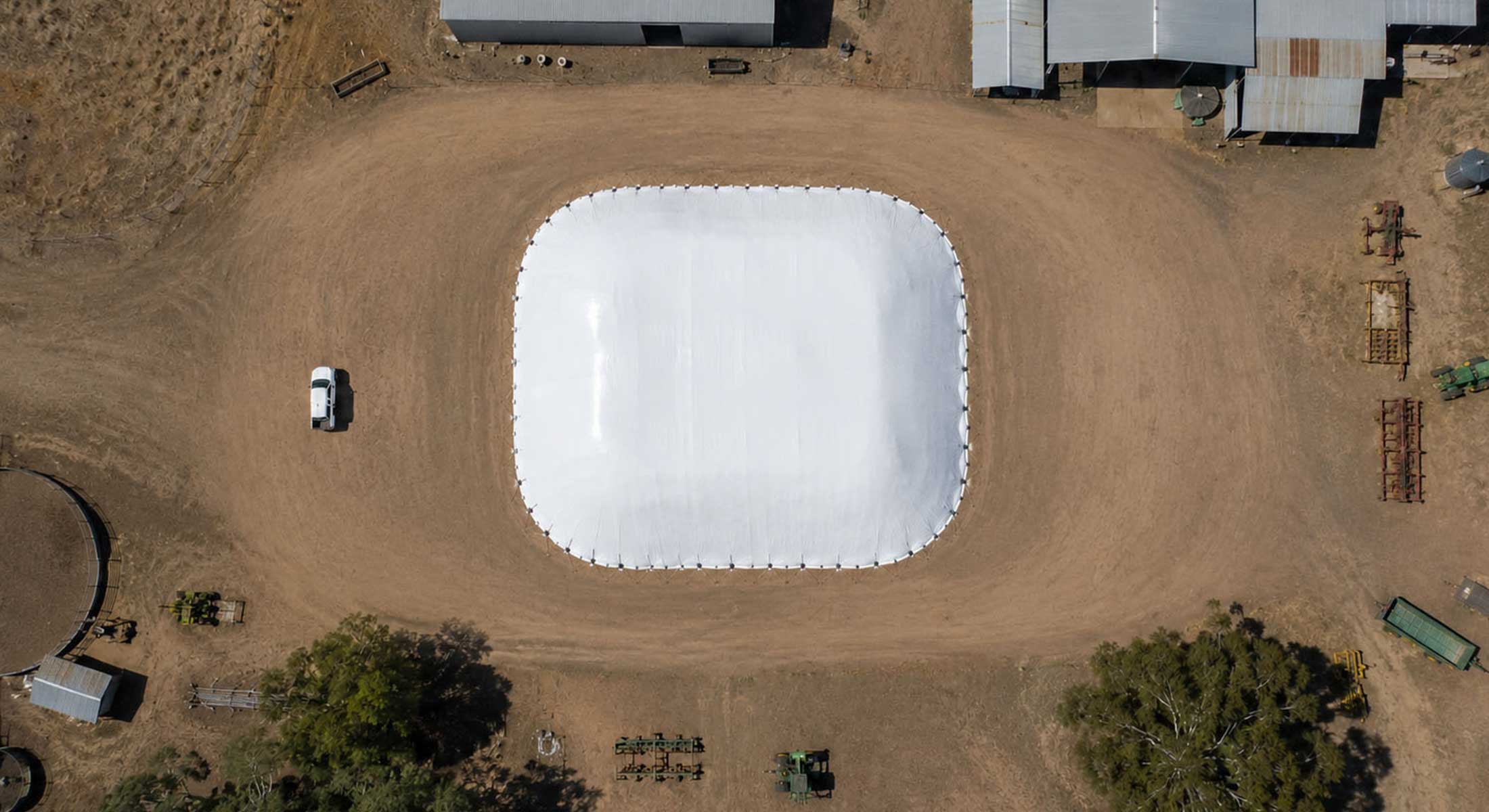
Protecting Grain, Hay and Feed
Why Australian Farms Rely on Stockpile Covers.
Every farmer knows the feeling of watching the sky change colour at the wrong moment during harvest — grain sitting in a windrow, fertiliser stacked and waiting for spreading, feed piled up ahead of a dry spell, and a weather system rolling in that has no respect for your schedule. Farm operations run on timing, and timing doesn’t always cooperate with what’s stored outside and exposed to the elements.
Stockpile covers exist to take that particular kind of stress off the table. A properly covered stockpile of grain, fertiliser or feed sits protected through whatever the sky throws at it — rain, dew, wind-driven moisture, harsh UV — while staying accessible enough to load, unload and manage as the season demands. For farms and rural properties dealing with genuine volumes of stored product, a quality stockpile cover isn’t a nice-to-have. It’s the difference between product that retains its value and product that quietly degrades while nobody’s looking.
Why Moisture Is the Enemy of Almost Everything You Store
Nearly every material stored in bulk on a farm shares one common vulnerability: moisture. Whether it’s grain, fertiliser, hay or feed, water getting into a stockpile sets off a chain of problems that range from reduced quality through to complete spoilage, and understanding why makes the case for proper covering pretty straightforward.
Grain that absorbs moisture is at immediate risk of mould growth and heating — a self-reinforcing process where damp grain generates its own heat through microbial activity and respiration, which in turn creates the conditions for further spoilage. Once a grain stockpile starts heating, the problem compounds quickly and can affect a much larger volume than the initial area of moisture ingress. Beyond mould, moisture-affected grain loses test weight, develops off-odours, and in serious cases becomes entirely unsuitable for sale or feed use.
Fertiliser is arguably even more moisture-sensitive. Most granular fertilisers are hygroscopic, meaning they actively absorb moisture from the air and readily cake, clump or break down structurally when exposed to rain or even sustained humidity. A bag or stockpile of fertiliser that’s been rained on can turn into a solid, unworkable mass that’s difficult or impossible to spread evenly, effectively wasting the product even though the nutrient content might technically still be there. For fertiliser stored ahead of a planting or top-dressing window, this kind of damage at the wrong moment can throw out an entire season’s input planning.
Hay and feed stored outdoors face a similar but slightly different challenge. Rain-affected hay develops mould and loses palatability and nutritional value, and in worse cases can become genuinely dangerous to feed out due to mycotoxin risk. Even a relatively light covering of moisture on the outer layers of a hay stack can be enough to render a meaningful portion of the stack unusable, particularly if that dampness sits against the hay for an extended period rather than drying out quickly.
A stockpile cover addresses all of these risks in the same fundamental way — by keeping rain and moisture off the stored material entirely, rather than trying to manage the consequences after the damage is already done.
Pest Pressure: The Problem You Don’t See Until It’s Too Late
Beyond moisture, stored grain, fertiliser and feed all attract unwanted attention from pests — and an uncovered or poorly covered stockpile is simply easier for birds, rodents and insects to access than one that’s properly sealed under a well-fitted cover.
Grain stockpiles are a particular draw for birds and rodents, both of which cause direct product loss through consumption as well as contamination through droppings, which can render otherwise good grain unsuitable for sale or feed use. A physical barrier over the top of a stockpile removes easy access and significantly reduces the opportunity for pests to establish themselves in and around stored grain.
Feed and hay stacks present similar challenges, with rodents in particular drawn to the shelter and food source that an accessible stack provides. Reducing that access through proper covering is one of the more straightforward and cost-effective pest management measures available, working alongside rather than replacing any dedicated pest control program already in place on the property.
A well-fitted stockpile cover isn’t a guaranteed pest-proof barrier — determined animals can still find their way to the edges of any covered stockpile — but a properly secured cover with minimal gaps genuinely reduces the accessibility and appeal of what’s underneath, which is a meaningful part of an overall protection strategy.
Grain Stockpiles: Getting Coverage Right at Harvest
Harvest season is when grain stockpile covering matters most, because it’s the point where large volumes of grain are sitting in the open — often for longer than anyone would ideally like, given the logistics of harvest timing, transport availability and storage capacity.
A grain stockpile under a quality cover stays protected from rain during exactly the period when it’s most exposed and most valuable. The window between harvest and either sale, transport or transfer to permanent storage is often when grain is most vulnerable, simply because it’s sitting in a temporary stockpile rather than a purpose-built silo or shed. A cover that goes on quickly, seals effectively around the pile, and can be removed and repositioned as the stockpile is worked through makes that vulnerable window far less risky.
Timing around harvest matters enormously here. Having stockpile covers on hand and ready to deploy before harvest begins — rather than scrambling to source one once grain is already on the ground and a weather system is closing in — is the difference between calm, controlled protection and a stressful last-minute race against the clock. For farms with predictable harvest timing, ordering and having covers ready well ahead of the season removes that risk entirely.
Fertiliser Stockpiles: Protecting an Expensive Input
Fertiliser represents a significant financial investment for most farming operations, and protecting that investment from weather damage is straightforward economics. A stockpile of fertiliser that’s been compromised by rain — caked, clumped, degraded — represents money that’s already been spent but that can no longer deliver its intended value when it comes time to spread.
Because fertiliser is often purchased ahead of when it’s actually needed — timed around price, availability or planning rather than the exact planting or top-dressing date — there’s frequently a storage gap where product needs to sit protected until it’s required. A stockpile cover over fertiliser during this gap keeps the product in spreadable condition right up until it’s needed, rather than degrading in storage and creating spreading difficulties or reduced application accuracy down the line.
Fertiliser stockpiles also benefit from covers that manage temperature as well as moisture, since some fertiliser types are sensitive to temperature extremes as well as direct moisture exposure. A cover that shields the stockpile from direct sun as well as rain provides a more stable storage environment overall.
Hay, Silage and Feed Overflow: Managing the Seasonal Surplus
Every farm with livestock deals with the seasonal reality of feed management — periods where hay, silage or feed supplies exceed what fits comfortably in permanent storage, and the overflow needs to sit outside, at least temporarily, until it can be moved, fed out or transferred to proper storage.
For hay specifically, a stockpile cover over the top of a stack protects the exposed surface from rain while the rest of the stack remains accessible for feeding out as needed. This is particularly valuable for larger operations where hay is stacked in the paddock or yard rather than under permanent cover, and where the volume involved makes moving everything into a shed impractical.
For general feed storage — grain-based feed, pelleted feed, or bulk feed supplies — the same moisture and pest protection principles apply as with grain stockpiles. A cover keeps feed dry and reduces pest access during periods when it’s sitting outside permanent storage.
Silage management on most farms typically relies on dedicated fermentation and sealing systems specific to that process, but where general feed overflow or supplementary hay needs weather protection during storage, a quality stockpile cover provides straightforward, practical protection for exactly that situation.
Sizing for Real Farm Volumes
One of the genuine differences between stockpile covers and general-purpose tarps is scale. Farm stockpiles — whether grain, fertiliser or feed — are often measured in tonnes rather than kilograms, and the covers needed to protect them are sized accordingly. Rather than the small to mid-size tarps used for trailers, sheds or general home use, stockpile covers are built to handle genuinely large surface areas, covering piles that might run many metres in length and stand several metres high.
This scale changes some of the practical considerations around using a stockpile cover effectively. Anchoring becomes more important across a very large surface — wind pressure on a large cover is considerable, and secure anchor points at regular intervals around the full perimeter are essential to keep the cover in place through exposed rural conditions. Positioning the pile itself with weather direction in mind, where practical, also reduces the wind load the cover has to manage on an ongoing basis.
For operations dealing with genuinely large stockpiles — grain at harvest, fertiliser ahead of a big season, hay stacked for winter feed — having a cover sized appropriately for the actual volume being protected, rather than trying to make do with something undersized, makes the whole exercise far more effective and far less frustrating to manage day to day.
Planning Ahead of the Season
The farms that get the most value out of stockpile covers are generally the ones that plan their covering needs ahead of the season rather than reacting once a weather event is already bearing down. Harvest timing, planting windows and feed management cycles are all reasonably predictable on most operations, which means the need for stockpile protection is predictable too.
Having covers on hand, in good condition, and ready to deploy before they’re urgently needed removes a whole category of last-minute stress from what’s already a demanding time of year. It also means covers can be positioned and secured properly, rather than thrown on hastily as rain starts falling — which matters both for how well the cover performs and for how long it lasts under regular use.
For farms managing multiple stockpiles across a season — grain at harvest, fertiliser ahead of application, feed through the colder months — having the right covers as a standing part of the farm’s equipment, rather than a reactive purchase, is simply good operational practice.
Protecting What You’ve Grown, Bought and Stored
Grain, fertiliser, hay and feed all represent real investment — of time, money, and in the case of grain and hay, an entire season’s effort. A stockpile cover is one of the more straightforward and cost-effective ways to protect that investment against the moisture and pest pressure that Australian weather and rural conditions consistently present.
Getting stockpile covers on hand ahead of harvest, ahead of a big fertiliser delivery, or ahead of the season where feed reserves need managing, means the protection is there exactly when it’s needed rather than being sourced under pressure once damage is already underway.
Browse the full range of Stockpile Covers at Discount Tarpaulins and find the right size and coverage for your farm’s storage needs this season.
