


Polyester vs Polypropylene Webbing
What’s the Difference?
At first glance, one length of webbing can look pretty much like another. It’s flat, woven, flexible and comes in a variety of colours. How different could two types really be?
As it turns out, quite different. Polyester and polypropylene webbing might look similar, but each has characteristics that make it better suited to particular jobs. Whether you’re replacing handles on a bag, reinforcing a tarp, making equipment straps or tackling a DIY project around the home, choosing the right material can make a difference to how well the finished product performs.
The good news is that you don’t need to be a textile expert to work out which one to use. Understanding a few basic differences in strength, stretch, durability and moisture resistance will help you make a more informed choice.
What Is Webbing and What Is It Used For?
Webbing is a strong, flat woven fabric commonly used to make straps, handles, attachment loops and reinforcement. Unlike rope, which has a round construction, webbing spreads contact across a wider, flatter surface. This makes it particularly useful for applications where a strap needs to sit neatly against another material or distribute pressure over a larger area.
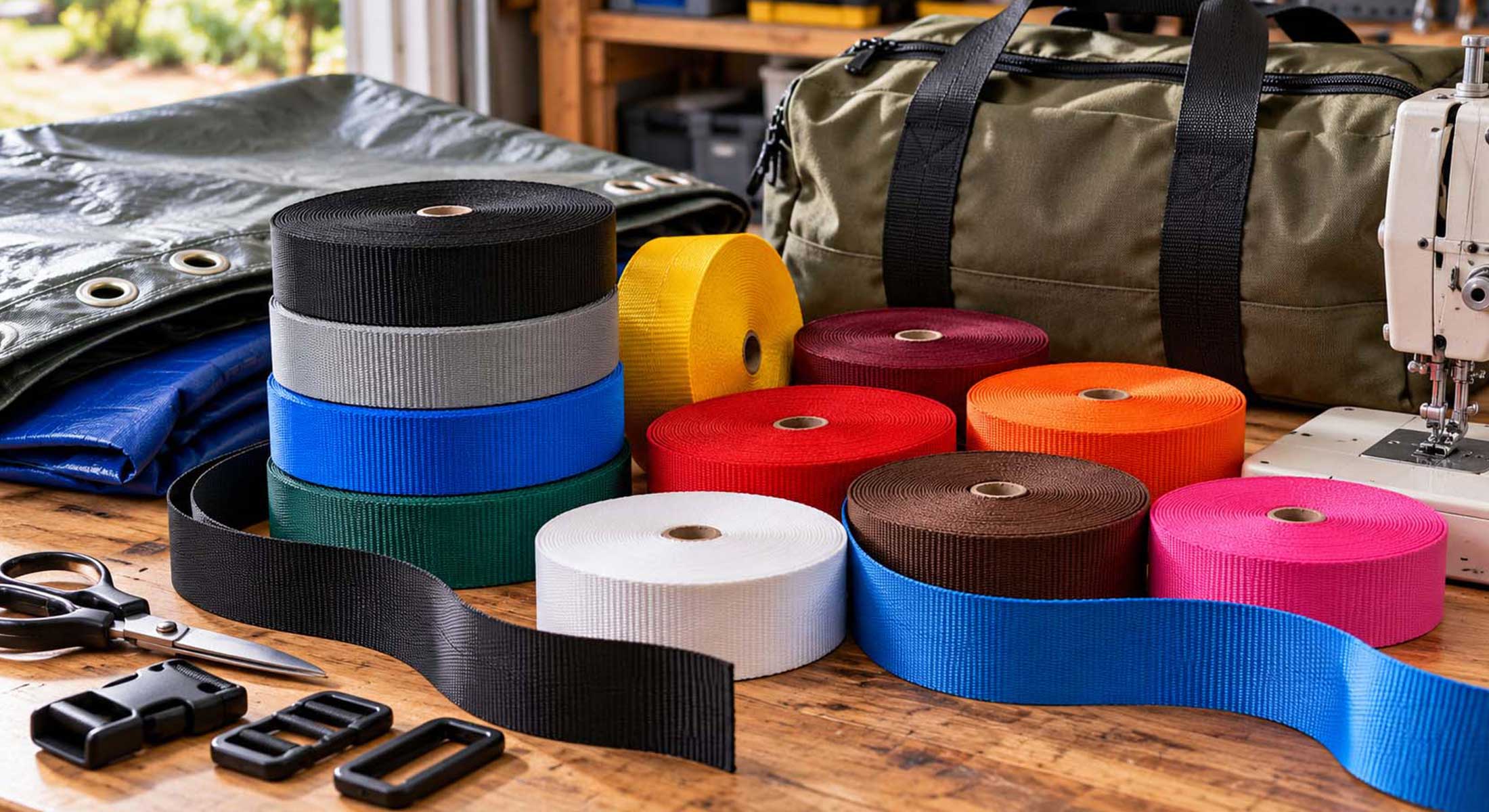
You’ll find webbing in backpacks, luggage, outdoor equipment, camping gear, tarpaulins, furniture and all sorts of everyday products. It’s also popular with people who enjoy making or repairing their own equipment because it can be cut to length and sewn into custom straps, handles and reinforced sections.
Two of the most common synthetic materials used to manufacture webbing are polyester and polypropylene. Both are versatile, but there are some important differences worth understanding before you start your next project.
Polyester Webbing: Strong, Durable and Dependable
Polyester webbing is a popular choice when durability and dimensional stability are important. It generally offers good tensile strength, resistance to abrasion and relatively low stretch, which makes it useful for straps and other applications where you don’t want the material continually changing length under tension.
One of polyester’s biggest advantages is its resistance to sunlight. Compared with standard polypropylene, polyester generally holds up better to prolonged UV exposure. That makes it a sensible material to consider for outdoor projects, particularly in Australia, where strong sunlight can be hard on synthetic fabrics.
Polyester also absorbs very little moisture, so getting wet doesn’t dramatically change its dimensions or performance. This makes it useful for camping equipment, outdoor covers and other items that may occasionally be exposed to rain or damp conditions.
At Discount Tarps, polyester seat belt webbing is available in a 50mm width and several colours. Despite the name, seat belt-style webbing is also used for a variety of non-automotive applications where a wide, durable strap is required. However, general-purpose webbing should not be assumed suitable for vehicle safety restraints or other safety-critical applications without the appropriate certification.
Polypropylene Webbing: Lightweight and Versatile
Polypropylene webbing offers a different set of advantages. It’s lightweight, flexible and generally more economical than polyester, making it a practical choice for many everyday projects where maximum strength and long-term outdoor durability aren’t the main priorities.
One particularly useful characteristic is its resistance to water absorption. Polypropylene fibres absorb virtually no water, which means the material doesn’t become significantly heavier simply because it’s wet. Polypropylene is also less dense than water, so suitable webbing can float, although any attached hardware or other materials may affect this.
This makes polypropylene worth considering for projects involving occasional exposure to water, damp storage conditions or equipment used around pools, boats and camping areas.
Polypropylene is also commonly used for bag handles, adjustable straps, storage organisers and other lighter-duty applications. It’s available in a wide range of colours, which can be handy when appearance matters as much as practicality.
The main trade-off is durability. Standard polypropylene webbing generally has lower resistance to UV exposure and abrasion than polyester, although specially treated products can perform differently. For something that will spend a lot of time outdoors in direct sunlight, polyester is often the more suitable starting point.
Which Webbing Is Stronger?
In general, polyester webbing offers greater strength and durability than comparable standard polypropylene webbing. That makes it a popular choice for applications where straps need to resist regular pulling, tension or wear.
However, it’s important to remember that the fibre material is only part of the story. The width, thickness, weave and construction of the webbing all influence its strength. A heavy-duty polypropylene product may perform differently from a lightweight polyester product, so comparing the two based on material alone doesn’t tell you everything.
For general household projects, consider how much tension the strap will experience and how often it will be used. A handle on a lightweight storage bag has very different requirements from a strap that is regularly pulled tight around equipment.
If the webbing is intended for lifting, vehicle load restraint or other safety-critical purposes, always use a product specifically rated and approved for that application. General-purpose webbing should never be treated as a substitute for certified restraint equipment.
What About Stretch?
Stretch is another difference worth considering, especially when making adjustable straps or reinforced covers.
Polyester webbing is generally known for its relatively low stretch under load. Once tensioned, it tends to maintain its length well, which can be useful for straps that need to remain consistent during normal use.
Polypropylene webbing also has relatively limited stretch compared with elastic materials, but its elongation and tendency to deform under sustained load can be greater depending on the construction. Over time, this can affect how well a strap maintains its original dimensions.
Neither polyester nor polypropylene webbing should be confused with elastic shock cord. If you need something specifically designed to stretch and contract repeatedly, conventional webbing isn’t the right material.
For most DIY projects, the important consideration is whether you want a strap that maintains its shape and length reliably or whether a lighter, more flexible material is sufficient.
Which Is Better Around Water?
Both polyester and polypropylene can be useful in damp environments, but they behave a little differently.
Polyester absorbs very little water and generally maintains its strength and shape well when wet. Combined with its good UV resistance, this makes it a versatile option for outdoor equipment and projects exposed to changing weather conditions.
Polypropylene absorbs even less moisture and has the added advantage of being lightweight enough to float. That can make it appealing for certain water-related applications, provided the particular webbing is suitable for the job.
However, moisture resistance doesn’t automatically mean a product is ideal for permanent outdoor use. Sunlight, abrasion, temperature and the way the webbing is attached can all affect how long it lasts.
For a project that will regularly be exposed to both sun and rain, polyester will often be the more durable option. For lighter-duty applications where low weight and minimal water absorption are priorities, polypropylene may be perfectly suitable.
Choosing Webbing for Outdoor Projects
If you’re planning to use webbing outdoors, it’s worth thinking beyond whether the material is waterproof or water-resistant. How much sunlight will it receive? Will it rub against other surfaces? Will it be pulled tight regularly, or is it simply holding something in position?
For example, webbing used to reinforce a tarp edge may be subjected to tension and repeated movement. In that situation, durability and abrasion resistance are important considerations. Polyester webbing may offer advantages, particularly if the cover will spend extended periods outside.
On the other hand, if you’re making a lightweight storage strap for camping equipment that spends most of its time packed away, polypropylene may provide everything you need without the extra cost.
It’s also worth remembering that stitching, buckles and attachment points are part of the finished product. Even strong webbing can fail if it’s poorly sewn, damaged or attached to unsuitable hardware.
Everyday DIY Uses for Polyester and Polypropylene Webbing
One of the reasons webbing is such a handy material to keep around is the variety of things you can make with it.
Polyester webbing can be useful for reinforcing fabric covers, making durable carry handles, replacing worn straps on outdoor equipment and creating attachment loops for suitable non-safety-critical applications. Its strength, low stretch and resistance to weathering make it particularly appealing for projects that need to stand up to regular use.
Polypropylene webbing is well suited to lighter-duty jobs such as bag handles, storage organisers, adjustable accessory straps and homemade camping equipment holders. Its lighter weight and range of colours also make it popular for craft and sewing projects where appearance and convenience are important.
Both materials can be used with suitable buckles, adjusters and other fittings to make practical custom straps. Just make sure the fittings are compatible with the width and thickness of the webbing, and that the complete assembly is appropriate for its intended purpose.
So, Which Webbing Should You Choose?
If you’re looking for webbing that offers good strength, abrasion resistance, low stretch and better resistance to prolonged sunlight, polyester is generally the stronger choice. It’s particularly worth considering for outdoor equipment, reinforcing covers and projects where durability is a priority.
If you need something lightweight, flexible and economical for everyday straps, bags, storage or occasional outdoor use, polypropylene may be the more practical option. Its minimal water absorption is another useful advantage in the right circumstances.
Neither material is automatically the best choice for every job. The important thing is to consider where the webbing will be used, how much wear it will experience and what you need it to do.
Discount Tarps stocks both polyester and polypropylene webbing in 50mm widths, with a choice of colours to suit different projects. Whether you’re repairing something that’s seen better days or making something from scratch, having the right webbing can make the job easier and the finished result more durable.
And as with most DIY projects, choosing the right material at the start is usually easier than doing the whole job twice.
