


Lawn Clippings, Prunings and Garden Waste
Why a Tarp Is the Smartest Tool in the Shed!
If you’ve ever spent a Saturday afternoon doing a proper garden tidy-up — mowing, pruning, raking, hacking back overgrown shrubs — you’ll know that the actual gardening part is only half the job. The other half is dealing with the pile of green waste you’ve generated, getting it from where it fell to where it needs to go, and doing that without making twelve trips back and forth across the lawn with a wheelbarrow that tips over every time you hit a root.
There’s a better way to do it. In fact, there are two better ways, depending on whether you’re moving green waste around the garden or transporting it somewhere else entirely. And both of them involve a tarp.
This isn’t a new idea — gardeners and groundskeepers have been using tarps for green waste collection and transport for a long time — but it’s one that a surprisingly large number of home gardeners haven’t come across yet. Once you try it, the wheelbarrow starts to feel like the backup option rather than the go-to.
The Problem With Moving Green Waste the Traditional Way
Let’s be honest about what moving garden waste usually looks like in practice. You rake or pile clippings and prunings into a heap. You grab the wheelbarrow. You try to load the heap into the wheelbarrow, which involves a lot of bending, scooping and watching armfuls of light clippings slide off the sides. The wheelbarrow fills quickly because green waste is bulky and takes up an enormous amount of volume relative to its weight. You make a trip. You come back. You do it again. By the end of the afternoon you’ve moved the equivalent of a small hill, one frustrating barrow-load at a time.
For heavier prunings and branches, the wheelbarrow works reasonably well. But for light, bulky material — lawn clippings, leaves, light hedge trimmings, pulled weeds — it’s genuinely inefficient. The material doesn’t stack or compress well, it falls off the sides, and the trips add up quickly on a larger garden.
A tarp solves most of these problems in one go.
The Drag Sheet Method: Work Smarter, Not Harder
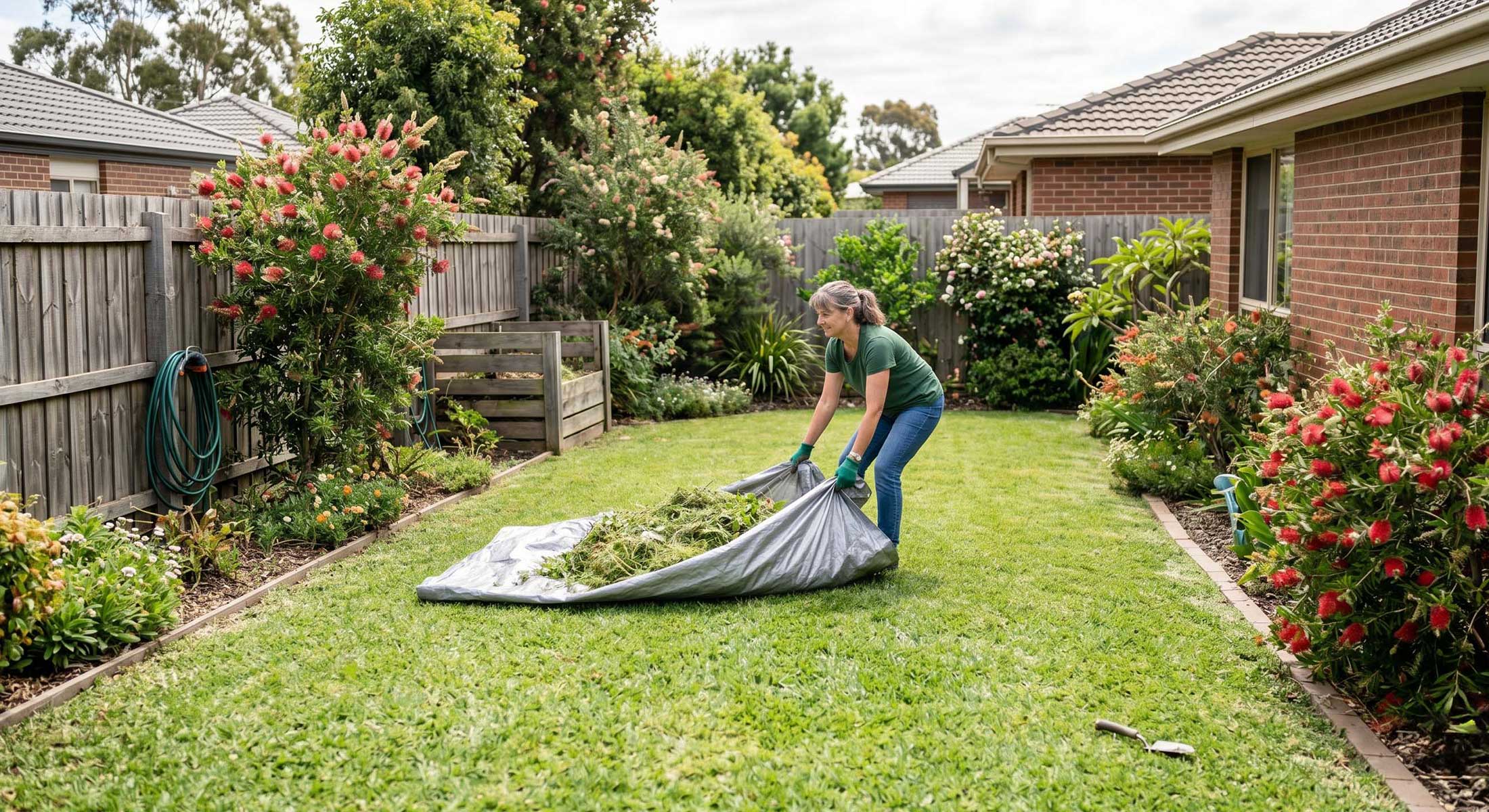
The drag sheet approach is exactly what it sounds like, and its simplicity is the whole point. Lay a poly tarp flat on the ground next to where you’re working — whether that’s under a tree you’re pruning, beside the garden bed you’re weeding, or at the end of each mowing pass. As you work, drop the clippings, prunings and debris directly onto the tarp. When it’s loaded, gather the corners, drag it to your compost, green waste bin or pile, and tip it out. Then bring it back and start again.
What makes this so effective is that a tarp can hold an enormous volume of loose green waste in a single load — far more than a wheelbarrow — and moving it requires no lifting at all. You’re dragging a flat sheet across a lawn or garden surface, which is dramatically easier than lifting a loaded wheelbarrow, particularly across uneven ground or on a warm afternoon when you’ve already been at it for a couple of hours. Your back notices the difference immediately.
It also keeps your work area clean as you go. Rather than raking clippings into a temporary pile and then moving them later, you’re collecting directly onto the tarp in real time. Pull a branch, drop it on the tarp. Rake a section of lawn, push the clippings onto the tarp. By the time you’ve finished an area the tarp is loaded and ready to move rather than the cleanup being a second separate job.
For this application, a heavy duty poly tarp is the right tool. Our CrocSkin poly tarps in the 240gsm range are ideal for drag sheet use — they’re robust enough to handle being dragged across rough ground, gravel paths and lawn edges without tearing, UV stabilised for long-term outdoor use, and available in sizes that suit everything from a small courtyard garden to a large suburban block or rural property. The reinforced eyelets and hem edges hold up well to the repeated gathering and dragging that this kind of use involves, and the fully waterproof laminated surface makes them easy to hose clean at the end of the job.
Choosing the right size matters here. Too small and you’re limiting how much you can load in a single drag. Too large and an empty tarp becomes unwieldy to position and move around the garden. For most suburban gardens, a mid-range size gives you the capacity to make the job genuinely efficient without the tarp becoming a burden to manage. For larger properties with significant garden waste volume, a larger tarp pays for itself quickly in time and effort saved.
Green Waste and Airflow: Why Mesh Beats Poly for Transport
The drag sheet method is brilliant for moving green waste around the garden — from where it falls to the compost heap, the green waste bin, or a collection pile at the edge of the property. But when green waste needs to go further — in the back of a ute, on a trailer, or in an open vehicle — the right tarp for the job changes.
Fresh green waste is alive in a way that most materials you’d transport aren’t. It’s wet, it’s decomposing from the moment it’s cut, and it generates heat and gases as it breaks down. Covering fresh clippings, lawn waste or green prunings with a fully waterproof solid tarp for transport traps all of that heat and moisture underneath, creating a sweaty, compressed mass that starts to break down rapidly and smells noticeably worse by the time you arrive at the tip or green waste facility.
A mesh cargo tarp solves this entirely. Rather than sealing the load, a mesh tarp contains it — stopping loose material from blowing off the back of a ute or trailer at highway speeds — while allowing air to flow freely through the open weave. The load stays ventilated, heat and moisture can escape, and the green waste arrives in much the same condition it left in rather than having spent the journey effectively composting inside a sealed cover.
This matters practically as well as in terms of comfort. Green waste facilities and council tip sites often have requirements around covered loads, and a mesh tarp satisfies those requirements while being far more appropriate for the material than a solid cover. It also means less mess when you unload — green waste that’s been sealed under a solid cover tends to become a compressed, soggy mass that sticks together and is harder to tip out cleanly than the same material transported under breathable mesh.
Our CrocSkin 350gsm Reinforced Mesh Cargo Tarps are the right choice for this application. The 350gsm weight means the mesh has real substance — it’s not shade cloth or lightweight netting, but a heavy duty cargo mesh with reinforced eyelets, transport load-rated seatbelt webbing around the perimeter, and stainless steel D-rings and snap hooks for secure attachment. It holds loose material in at highway speeds, handles the weight of a full load of green prunings without stretching or deforming, and is easy to attach and remove quickly at both ends of the trip.
The mesh is available in multiple sizes to suit different ute trays and trailer sizes, and because it’s designed for genuine load securing rather than just light covering, it gives you confidence that the load is properly contained rather than just loosely covered.
Poly for the Garden, Mesh for the Road: Using Both Together
For anyone who does regular garden maintenance — whether that’s your own block, a rental property, or a larger rural holding — having both a poly drag sheet and a mesh cargo tarp in the shed is genuinely useful. They complement each other naturally, covering the full green waste workflow from collection through to transport and disposal.
The poly tarp handles the on-ground work — collecting, moving and tipping green waste around the garden with minimal effort and no lifting. The mesh tarp handles the transport stage — securing a loaded ute tray or trailer for the trip to the tip or green waste facility with proper ventilation and reliable containment.
Neither is trying to do the other’s job, and each is the right tool for the specific task it’s used for. That’s the kind of practical efficiency that makes a real difference over the course of a gardening season, particularly on larger properties where green waste is generated in significant volumes and moving it efficiently saves meaningful time and effort.
Other Garden Uses Worth Knowing About
While green waste is the focus here, it’s worth noting that both poly and mesh tarps earn their place in the garden well beyond just moving clippings and prunings.
A poly tarp laid under a tree before pruning catches falling debris as you work, making the clean-up afterwards a simple matter of gathering the corners rather than raking across a wide area of lawn. The same approach works for any overhead work — cleaning gutters, trimming hedges, spraying — where catching the debris at ground level saves significant time.
Poly tarps are also useful as temporary weed suppression covers over garden beds being prepared or rested, as ground sheets under compost bays to catch any liquid runoff, and as protective covers for garden furniture, potted plants and equipment during periods of heavy rain or frost.
Mesh tarps work well as windbreak screening around exposed vegetable gardens or young plantings, as shade cloth alternatives for areas that get too much direct afternoon sun, and as debris containment during any garden renovation work where light material might otherwise blow around the yard.
Getting More Out of Your Garden Routine
Green waste is one of those jobs that never quite goes away — there’s always something to mow, prune, rake or clear, and in a well-maintained garden the volume can be significant. Having the right tools for moving that waste efficiently means less time on the cleanup and more time on the actual gardening.
A heavy duty poly tarp for drag sheet collection and a reinforced mesh cargo tarp for transport are two of the most practical and affordable additions to a garden shed that most people haven’t thought to make yet. Once you’ve used them through a season of garden maintenance, going back to the wheelbarrow-only approach starts to feel like unnecessary hard work.
