


How to Clean, Dry and Store Your Canvas Tarp
A good canvas tarp is one of those purchases that should last you many years. Unlike poly tarps that degrade under UV and eventually become brittle and crack, or lightweight covers that tear under the first real load, a quality canvas tarp gets better with age — developing a kind of seasoned resilience that makes it more comfortable to handle and increasingly effective at repelling moisture over time. Our CrocSkin canvas tarps are built with that longevity in mind, but like any quality product made from natural or poly-cotton fibres, they need a bit of care to reach their full potential lifespan.
The good news is that canvas care isn’t complicated. It doesn’t require special equipment, expensive products, or a lot of time. What it does require is doing the right things in the right order — and perhaps more importantly, avoiding a few common mistakes that quietly shorten a canvas tarp’s life without any obvious warning signs until the damage is already done.
Why Canvas Needs Different Care Than Synthetic Tarps
It’s worth starting here, because the instinct a lot of people have is to treat a canvas tarp the same way they’d treat a poly or PVC one — hose it off, shake it out, fold it up and put it away. With synthetic tarps that approach is largely fine. With canvas it can cause real problems over time.
Canvas is a woven fabric made from natural or poly-cotton fibres, and those fibres behave very differently from synthetic materials in response to moisture, heat, cleaning products and storage conditions. Moisture trapped in canvas fibres — whether from inadequate drying, being folded while damp, or being stored in a confined space without airflow — creates exactly the conditions that mould and mildew thrive in. Once mildew takes hold in canvas fibres it’s difficult to remove completely, and repeated mildew growth gradually breaks down the integrity of the fabric itself.
Similarly, harsh cleaning products that would be perfectly safe on a PVC surface can strip the natural oils from canvas fibres, leaving them dry and brittle, or cause colour changes and uneven patches that are impossible to reverse. The fibres in canvas also don’t respond well to sustained high heat — whether from a clothes dryer, a hot pressure washer, or being left folded in direct sun for extended periods.
Understanding these characteristics isn’t complicated — it just means approaching canvas care with a little more attention than you’d give a plastic tarp, and the tarp will reward that attention with a service life that makes the investment genuinely worthwhile.
Regular Maintenance: The Little Things That Make a Big Difference
The easiest canvas care happens in the field, during normal use, and it requires almost no effort at all. Shaking loose debris, leaves, dirt and dust off the tarp regularly — before it has a chance to accumulate and work its way into the weave — is one of the most effective things you can do to keep canvas in good condition between proper cleans.
When a canvas tarp is in use outdoors, try to avoid letting standing water pool on the surface for extended periods. Canvas handles rain and moisture well when it can drain freely, but water that sits in a low point of an improperly pitched tarp — or collects in a fold or crease — stays in contact with the fibres far longer than it should. Over time this creates soft spots and areas of accelerated fibre wear. Keeping the tarp properly tensioned and pitched so water runs off rather than pools is simple to do and protects the fabric considerably.
If your tarp picks up tree sap, bird droppings or other spot soiling during use, deal with it sooner rather than later. Fresh organic staining is always easier to remove than dried, set-in staining, and the longer it sits the more chance it has to work into the weave where it becomes genuinely difficult to shift. A damp cloth and a mild, canvas-appropriate cleaner applied to the spot and worked gently into the fibres will usually handle fresh staining cleanly. Avoid rubbing aggressively — work the cleaning solution in with a soft brush using circular motions and let it do the work rather than relying on mechanical scrubbing force, which can damage the weave.
How to Clean a Canvas Tarp Properly
A thorough clean is something your canvas tarp will benefit from at least once a season, or whenever it’s picked up significant soiling during use. The process is straightforward, but the details matter.
Start by laying the tarp out flat on a clean surface — a lawn, a driveway, or a couple of saw horses work well. Give it a good shake and brush off any loose dirt, leaves or debris before introducing any water. Washing dirt into the weave with water before brushing it off first just makes the cleaning job harder and pushes grit deeper into the fibres.
Once the loose debris is cleared, rinse the tarp thoroughly with a garden hose on a gentle setting. The goal at this stage is simply to wet the fabric evenly and flush out surface dirt before applying any cleaning solution. Avoid using a high-pressure washer — the concentrated pressure can force water and grime deeper into the weave, damage the fibre structure, and strip the surface of the fabric in ways that affect its long-term performance.
For general cleaning, a mild soap or canvas-appropriate cleaner diluted in a bucket of cool to lukewarm water is all you need. Apply the solution with a soft-bristled brush — a scrubbing brush or a large car wash brush works well — and work it into the fabric using gentle circular motions across the full surface of the tarp. Pay extra attention to any heavily soiled areas, seams and grommet reinforcements where dirt tends to accumulate. Work both sides of the tarp if the soiling warrants it.
When it comes to mould or mildew spots — which appear as dark or greenish patches, often with a musty smell — treat them with a suitable canvas cleaner designed for mildew removal, following the product’s instructions carefully. Work the solution into the affected area with a soft brush and allow it sufficient dwell time before rinsing. Persistent mildew may require a second treatment. It’s worth being realistic that severe mildew that has been left untreated for an extended period may not come out completely — this is exactly why catching it early and storing canvas properly in the first place matters so much.
Once you’ve worked the cleaning solution across the full tarp, rinse thoroughly with the hose until the water running off is completely clear and no soap residue remains. Soap left in the fabric can attract dirt more readily, create uneven patches, and affect the fabric’s behaviour over time. Take your time with the rinse — it’s the step most people rush, and it’s worth doing properly.
Drying: The Most Important Step of All
If there’s one step in canvas care that matters more than any other, it’s this one. Drying canvas completely — genuinely, thoroughly, no residual moisture anywhere in the fabric — before folding and storing it is non-negotiable. Every mildew problem, every musty smell, every patch of fibre breakdown that appears in a canvas tarp that was “stored clean” almost always traces back to insufficient drying before storage.
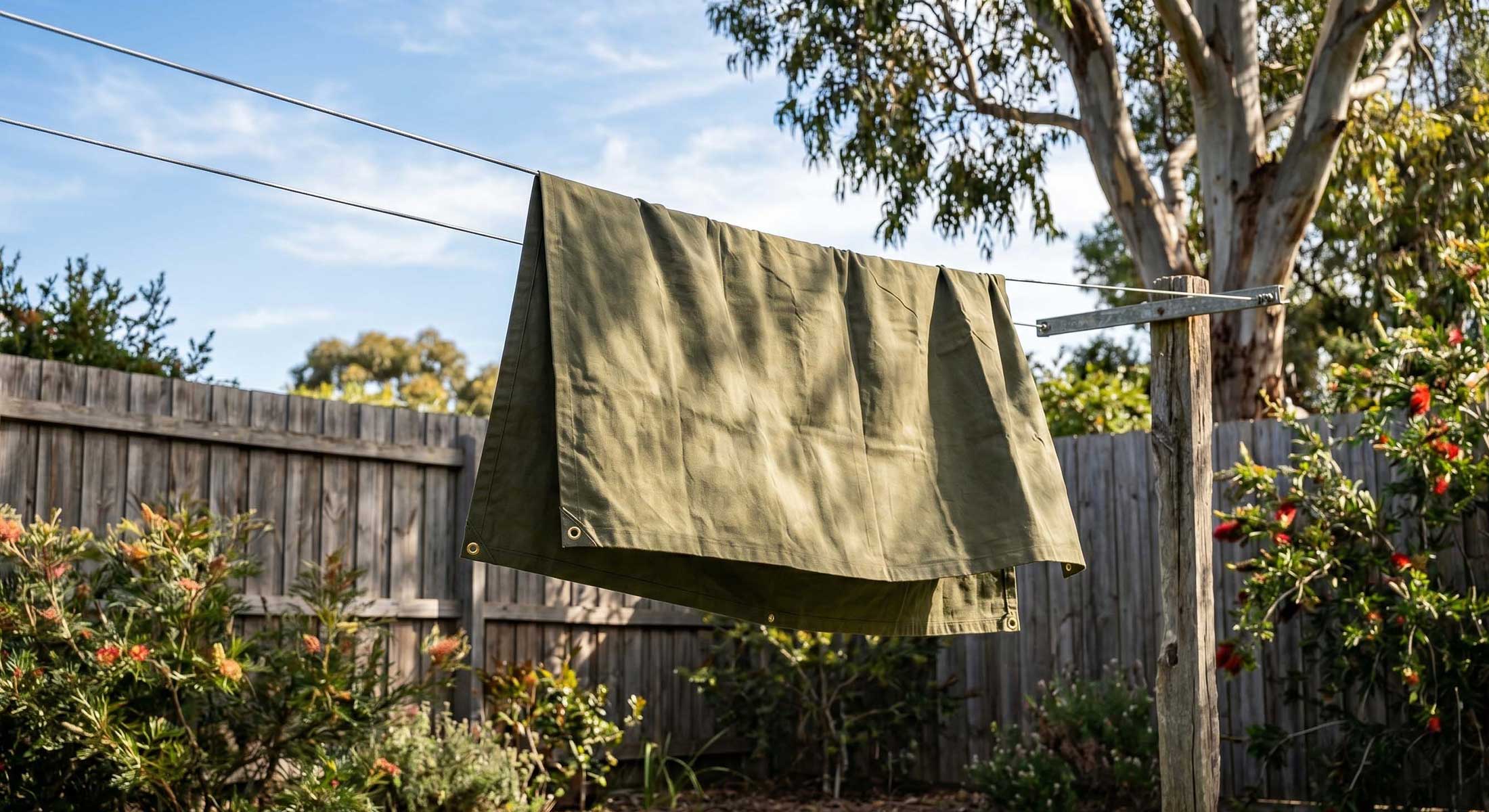
The right way to dry a canvas tarp is to hang or drape it in a well-ventilated position out of direct, intense sun, with as much airflow as possible moving across both faces of the fabric. A clothesline, a fence, a couple of saw horses, or a railing work well — the goal is to get the tarp off the ground with air able to circulate on both sides simultaneously rather than having one face pressed against a surface where moisture can’t escape.
A light breeze is your best friend at this stage. Moving air carries moisture away from the fabric surface far more effectively than still air, and a canvas tarp that might take most of a day to dry in still conditions can be ready in a couple of hours on a breezy day. If you have the option, pick a day with both reasonable warmth and some wind for your canvas cleaning session.
Direct, intense midday sun speeds the drying process but should be used cautiously — prolonged exposure to very strong UV while the tarp is wet can be harder on the fibres than normal use, and repeated cycles of intense wet-sun-dry can contribute to long-term colour fading. Drying in the morning or late afternoon sun with good airflow is ideal. In cooler weather or overcast conditions, just allow more time and make absolutely sure the tarp is completely dry before it goes away — even slightly cool or faintly damp canvas will develop mildew in storage.
Before you fold and store the tarp, feel the fabric on both sides across several different areas — not just the face you can see easily. Pay particular attention to seams, reinforced edges and grommet areas, where the multiple layers of material take longer to dry than the single-layer body of the tarp. These thicker sections hold moisture longer and are often where mildew first appears in a tarp that seemed dry before storage. If in doubt, leave it out for longer. An extra hour of drying time costs nothing. A mildew-compromised tarp is a real problem.
Dealing With Mildew: Early Action Makes All the Difference
Even with the best care, mildew can sometimes appear — particularly on tarps used in humid coastal areas, or after an unusually wet season. The key with mildew is catching it early and treating it promptly, before it has time to spread and work deeper into the fibres.
Mildew typically appears as dark spots or patches, often with a musty or earthy smell that’s noticeable when you unfold the tarp. If you spot it, don’t fold the tarp back up and deal with it later — address it immediately. Mildew spreads in the warm, dark, confined conditions of a storage bag or shed shelf, and a small patch can become a significant problem in a matter of weeks.
Treat affected areas with a canvas-appropriate mildew cleaner, work it in gently with a soft brush, and allow adequate dwell time before rinsing. Once treated and rinsed, the tarp must go through the full drying process described above before being stored — putting a damp tarp away after mildew treatment simply creates the conditions for the mildew to return.
For tarp storage areas that have previously had mildew issues, look at the storage conditions rather than just treating the tarp. Mildew in stored canvas almost always comes down to one of three things — insufficient drying before storage, storage in a damp or poorly ventilated location, or storing the tarp in a tightly sealed container that traps any residual moisture. Address the root cause and the problem usually doesn’t return.
Folding and Storage: Setting Your Tarp Up for the Long Term
Once your canvas tarp is completely, thoroughly dry, how you fold and store it has a meaningful impact on its condition when you next pull it out. A few simple habits here make a real difference.
Fold the tarp loosely rather than tightly. Canvas stored in tight, compressed folds develops permanent crease lines over time, and those creases are points of mechanical stress where the fibre structure gradually weakens. A loose fold — particularly a roll rather than a flat fold if space permits — is much kinder to the fabric over an extended storage period. If you’re storing for a full season, consider unfolding and re-folding the tarp once partway through to prevent any fold lines from becoming permanent.
Store canvas in a cool, dry location with reasonable airflow. A shelf in a shed, a dedicated storage bag with ventilation, or a breathable canvas bag all work well. What doesn’t work well is a sealed plastic bag or airtight container — canvas needs to be able to breathe in storage, and sealing it completely traps any trace of residual moisture and prevents it from dispersing. Even a tarp that felt completely dry can release a small amount of residual moisture in storage, and in a sealed environment that moisture has nowhere to go.
Keep stored canvas away from direct contact with concrete floors, which are almost always damp and will wick moisture directly into the fabric. Even a timber pallet or a shelf keeps the tarp elevated and away from the moisture that concrete floors radiate, particularly through winter.
If your storage area is prone to rodents or insects, check on stored canvas occasionally through the off-season — canvas is an attractive nesting material for rodents, and damage from this source can be extensive if it goes unnoticed for months.
A Word on Seams, Eyelets and Edges
The body of a canvas tarp is usually the most durable part — it’s the seams, eyelets and reinforced edges that tend to show wear first, and keeping an eye on these areas during cleaning and storage helps catch minor issues before they become significant ones.
After cleaning, inspect each grommet while the tarp is laid out flat. Eyelets that are starting to pull away from the reinforcement, show rust staining on the surrounding fabric, or have small tears developing around their edges should be noted and addressed — an eyelet that fails under load can start a tear that propagates quickly through the body of the tarp. Similarly, check the stitching along seams and hems while the tarp is wet and laid flat, as this is when any weak points are most visible. A few stitches of repair work done early is far simpler than dealing with a seam that’s opened up significantly.
Eyelets showing rust staining are worth noting as a sign that the metal has started to corrode — dried thoroughly and stored properly, this progression slows considerably. Keep eyelet areas as clean and dry as possible, and they’ll remain functional for the full life of the tarp.
Making the Most of a Quality Investment
Canvas tarps represent a genuine step up from synthetic alternatives in durability, performance and character — and the maintenance routine described here is genuinely modest relative to the extended service life it produces. Clean when soiled, dry completely every single time before storage, store in a cool dry ventilated location, and check occasionally for early signs of mildew or wear. That’s really the whole routine.
A CrocSkin canvas tarp looked after this way will outlast several generations of lighter alternatives and continue performing well through years of real use — whether that’s covering firewood, sheltering a campsite, protecting equipment, or any of the other demanding applications that canvas handles so well.
