


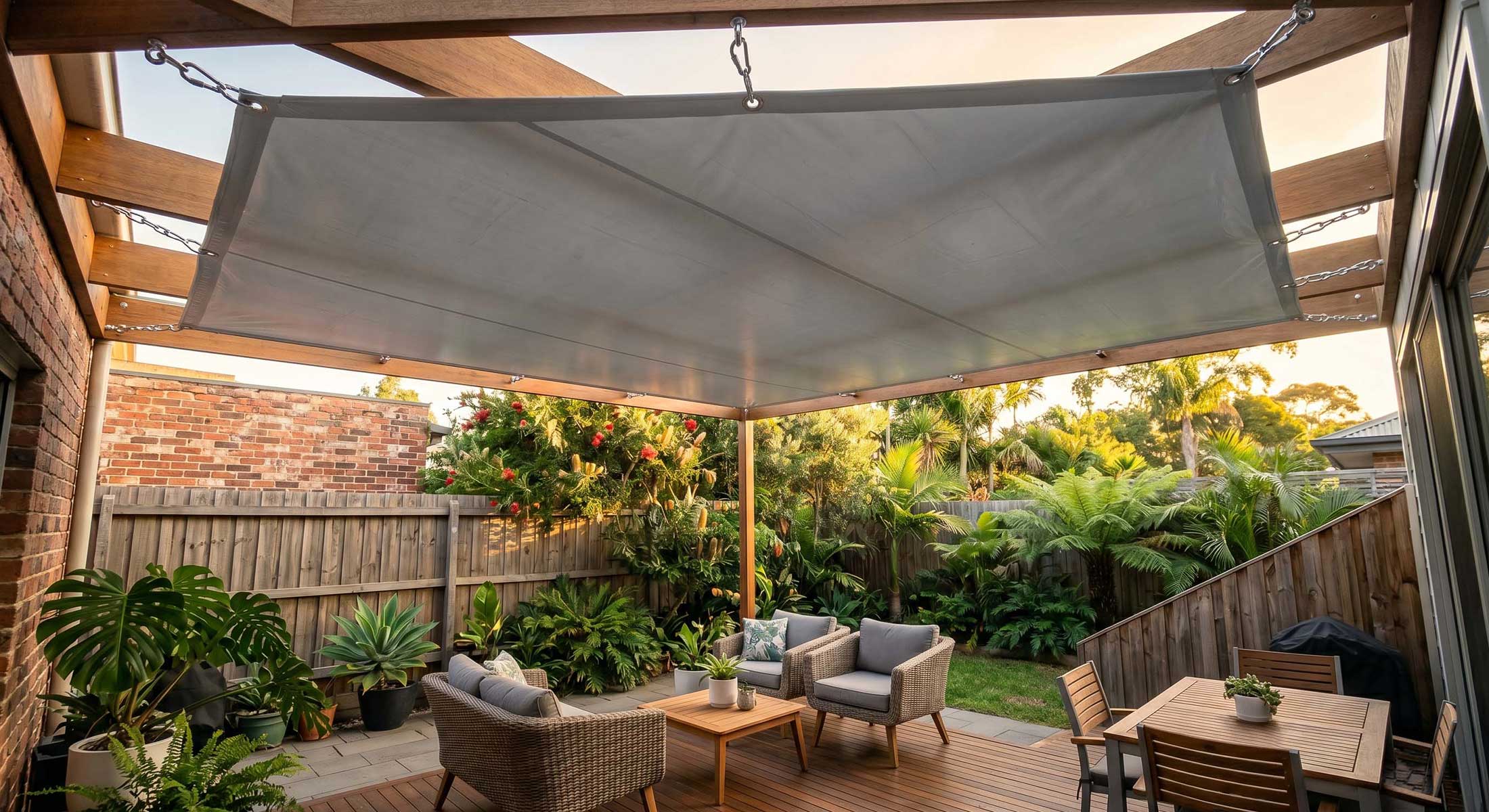
Custom Made Tarps: For Spaces That Don’t Fit the Mould
Most outdoor spaces aren’t designed with standard tarp sizes in mind. Pergolas get built to fit the available space rather than a catalogue dimension. Courtyards have walls at unexpected angles. Split-level decks create coverage challenges that a rectangular off-the-shelf tarp handles badly. Anchor points end up exactly where a standard eyelet spacing doesn’t. And so you end up with a tarp that’s either too big — bunched and folded at the edges, collecting water in the folds — or too small, leaving gaps that let in exactly the rain or wind you were trying to block.
This is a problem that a surprising number of people put up with unnecessarily, either because they don’t realise custom sizing is an option, or because they assume it’s complicated or expensive. In reality, getting a tarp made to your exact specifications is a straightforward process that produces a result so much better than a compromised standard size that most people wonder why they didn’t go down that route in the first place.
Why Standard Sizes Fall Short for Unusual Spaces
There’s nothing wrong with standard tarp sizes for standard applications — covering a rectangular trailer, protecting a woodpile, or throwing a cover over a straightforward flat surface. For these jobs an off-the-shelf size works perfectly well and there’s no reason to go custom.
The problems start when the space isn’t standard. And in the real world of Australian backyards, courtyards, pergolas and outdoor areas, non-standard is remarkably common.
A courtyard that’s slightly trapezoidal because the house wall isn’t quite parallel to the fence. A pergola bay that measures 3.4 metres wide — right between standard sizes. A shade structure that needs to cover a split-level deck where one attachment point is half a metre higher than the others. An outdoor entertaining area with a post in an awkward position that a standard tarp either misses or has to work around in an ungainly way. Any of these situations produces the same result when you try to solve them with an off-the-shelf tarp: a cover that sort of works but doesn’t quite fit, and that creates ongoing frustration every time you put it up or look at it.
A custom-made tarp solves all of these problems by starting from your actual space rather than a catalogue of fixed dimensions. The tarp arrives made to your measurements, with eyelets positioned where your anchor points actually are, in the material best suited to what you’re using it for. It fits properly, behaves properly, and looks like it belongs there rather than like a workaround.
Measuring for a Custom Tarp: Getting It Right Before You Order
The most important part of ordering a custom tarp is the measuring, and it’s worth taking the time to do it carefully and systematically before you place an order. A well-measured custom tarp fits first time and does exactly what you need it to. A poorly measured one is a disappointment that has to be redone.
Start by identifying exactly what you need the tarp to cover and where its edges will sit. For a shade or weather cover, this means measuring the full span from one attachment point to the other in both directions — not just the width of the opening, but the actual distance the tarp needs to span including any overlap onto beams, fascia boards or walls where the edges will be secured. Measure at multiple points across the span, not just at one end, because walls and structures are rarely perfectly parallel and a difference of even five or ten centimetres across a large span will result in a tarp that pulls unevenly or leaves a gap on one side.
For non-rectangular spaces — a courtyard that angles at one end, a triangular shade structure, or an L-shaped cover — take measurements at every point where the shape changes. The diagonal dimension across a non-rectangular space is just as important as the parallel edges, and providing all of these measurements when you order gives the maker everything they need to produce a shape that works.
Add a small amount to your measurements for attachment overlap — a tarp that just barely reaches your anchor points with no spare material is harder to attach than one with a few centimetres of overlap that can be folded neatly. How much overlap depends on your attachment method, but as a general guide, five to ten centimetres on each edge gives you comfortable working room without creating excess material that bunches.
For split-level applications or situations where the tarp needs to follow a slope or angle rather than lying flat, note the height difference between attachment points and the horizontal span separately. This allows the maker to understand the geometry and ensure the finished tarp covers the intended area correctly when it’s under the tension of being attached at different heights.
If your space has a complex shape that goes beyond a simple rectangle, trapezoid or triangle — an L-shape, for example, or a space with a cutout for a post or column — it’s worth reaching out to the team before ordering to talk through the shape and make sure what you have in mind is achievable. Most shapes can be made, but complex geometry benefits from a conversation upfront rather than assumptions on either side.
Eyelet Placement: The Detail That Makes Everything Work
Eyelet placement is where a custom tarp really earns its difference from an off-the-shelf product, and it’s the detail that most people don’t think about carefully enough when they’re planning their order.
On a standard tarp, eyelets are spaced at regular intervals around the perimeter — typically every 60 to 90 centimetres — without any reference to where your actual anchor points are. This works fine when your anchor points happen to align with standard eyelet spacing, and is a source of constant frustration when they don’t. A tarp that has to be attached via rope or bungee to an eyelet that’s 40 centimetres away from the actual anchor point sits badly, pulls at an angle, and never looks or performs as well as one where the eyelet lines up directly with where the attachment needs to be.
When ordering a custom tarp, you specify where you want eyelets placed rather than accepting a standard spacing. This means going through your anchor points one by one and mapping them to positions on the tarp perimeter. Take the time to physically stand at your installation location and work through where each rope, snap hook, bungee or fixing will attach — and mark those positions on a sketch of the tarp before ordering.
The number of eyelets also matters and is worth thinking through. More eyelets mean more attachment options and better distribution of load across the tarp edge, which reduces stress on any single point and helps the tarp sit flat without scalloping between attachment points. For large tarps or those that will be under significant wind load, additional eyelets along the span — not just at the corners — make a meaningful difference to how the tarp performs. For smaller covers or those in sheltered positions, fewer well-placed eyelets are perfectly adequate.
Corner eyelets deserve special attention regardless of the size of the tarp. Corners are the highest stress points on any cover, and making sure corner eyelets are positioned in a way that allows the corner to be properly tensioned — rather than pulling at an awkward angle — makes the whole installation sit better and last longer.
If you’re unsure about eyelet placement for a complex installation, making a rough template from string or rope and physically testing where your attachment points will land before ordering is a genuinely useful exercise. It takes twenty minutes and can save the cost and delay of a remade tarp.
Custom Canvas Tarps: Breathable, Durable and Genuinely Versatile
For outdoor spaces where breathability matters — courtyards, pergola enclosures, camp shelters, storage covers for equipment or firewood — a custom canvas tarp is a compelling option that combines natural material performance with made-to-measure precision.
Our Made to Order Canvas Tarps are available in the same quality CrocSkin canvas used across our standard range, which means you’re getting a material that’s proven in Australian outdoor conditions rather than a compromise product made specifically for custom orders. Canvas breathes naturally, handles condensation differently to synthetic alternatives, sits quietly in the wind, and develops a reassuring solidity over time that synthetic covers rarely match.
For courtyard shade structures or pergola side panels where the space is non-standard, custom canvas gives you a cover that fits the architecture properly rather than being forced into it. For unusual storage situations — oddly shaped equipment, vehicles with non-standard dimensions, machinery or boats that don’t fit neatly under a rectangular cover — a custom canvas shape can be made to follow the contours of what’s being covered far more effectively than an off-the-shelf alternative.
Custom canvas is also the right choice for anyone who wants the performance characteristics of canvas — the breathability, the weight, the natural feel — in a size or shape that simply doesn’t exist in the standard range. If the standard sizes are close but not quite right for your application, going custom closes that gap and produces a result that works properly rather than approximately.
Custom PVC Tarps: Maximum Weather Protection in Any Size or Shape
For applications where maximum waterproofing and weather resistance are the priority — pergola enclosures, outdoor entertaining areas exposed to significant rain and wind, commercial or semi-commercial shade and weather structures — a custom PVC tarp delivers the performance of heavy-duty PVC material in exactly the dimensions your space requires.
Our Made to Order PVC Tarps are available in 500gsm matte finish and 680gsm gloss finish, both of which are serious outdoor materials built for sustained exposure to Australian weather conditions. The ability to specify exact dimensions and eyelet placement is particularly valuable for PVC pergola enclosures, where panels that don’t fit precisely create gaps that defeat the purpose of the enclosure, and where eyelets that don’t align with attachment points mean panels that hang unevenly or require workarounds that compromise both appearance and performance.
For split-level outdoor areas — where one side of the cover sits higher than the other, or where the structure creates an angled rather than flat installation — custom PVC sizing allows the panel dimensions to account for that geometry properly. An off-the-shelf tarp stretched across a split-level opening either pulls too tightly on one side or hangs too loosely on the other; a custom panel made to the actual measurements of the angled span fits the installation as it actually exists.
The made-to-order PVC service is also the right solution for commercial or semi-commercial outdoor spaces where appearance matters as much as function — restaurants, cafes and hospitality venues with unusual outdoor configurations, event spaces with irregular dimensions, or any professional application where a visibly ill-fitting cover is not an acceptable outcome.
Custom Poly Tarps: Tough, Practical Coverage for Demanding Shapes
For heavy-duty covering applications where maximum toughness and cost-effectiveness are the priority — stockpile covers, machinery protection, construction site applications, agricultural use — a custom poly tarp in a non-standard size or shape delivers the durability of quality polyethylene in exactly the dimensions the job requires.
Our 450gsm PP Tarpaulin is a particularly robust option for demanding custom applications. At 450gsm this is a serious heavy-duty material — substantially heavier than standard poly tarps — with the strength and UV resistance to handle prolonged outdoor exposure in working environments. For stockpile covers, large machinery covers, or any application where the covered area has an unusual footprint that standard sizes don’t address efficiently, a custom poly tarp in this weight eliminates the waste and performance compromises of using multiple standard tarps overlapped or a larger tarp bunched at the edges.
Custom sizing also makes economic sense for large-scale applications. A single custom tarp made to cover a specific footprint precisely uses less material than the nearest oversized standard option, is easier to handle because it doesn’t have excess material to manage, and performs better because it sits flat rather than folding or gathering at the edges.
Custom Mesh and Shade Cloth: Ventilated Coverage for Every Shape
Mesh and shade cloth applications are where non-standard sizing is perhaps most common, because the spaces where mesh is typically used — vegetable garden enclosures, shade structures over seating areas, windbreak screens along irregular fence lines, fruit tree netting — are inherently variable in size and shape.
Our Made to Order Mesh and Shade Cloth Tarps cover both mesh cargo applications and shade cloth applications in custom dimensions, giving you the flexibility to cover an irregular garden bed, an unusually sized pergola opening, or a non-standard cargo area with a cover that actually fits rather than one that has to be tied back, cut down or overlapped to manage excess material.
For garden and horticultural applications specifically, custom sizing makes a significant practical difference. A shade cloth cut to the exact dimensions of a raised bed or growing frame sits flat, attaches cleanly at every edge, and does its job of managing light and heat consistently across the covered area. An oversized cloth bunched at the edges creates uneven shade, collects debris in the folds, and is more likely to catch wind and pull away from its attachments.
For windbreak applications along irregular fence lines — where the fence changes direction, varies in height, or has gaps and gates that need to be worked around — custom mesh panels in the specific dimensions of each section produce a far cleaner and more effective result than trying to adapt standard sizes to a non-standard run of fencing.
Eyelet placement is particularly important for mesh and shade cloth applications, where the attachment points are often at close, regular intervals to keep the material flat and prevent sagging between fixings. Specifying eyelet spacing to match your batten, post or wire spacing eliminates the problem of a mesh panel that attaches well at some points and hangs loosely between them.
The Ordering Process: Simpler Than You Might Think
For anyone who hasn’t ordered a custom tarp before, the process is more straightforward than it might sound. You don’t need to be a tradesperson or have technical drawing skills — you just need accurate measurements, a clear idea of where you want your eyelets, and a sense of which material suits your application.
Start with a simple sketch of the shape you need — even a rough hand-drawn diagram with dimensions marked clearly is enough to communicate the geometry. Note the overall dimensions, any non-rectangular angles or cutouts, and mark the positions of eyelets around the perimeter relative to the edges and corners. If you have specific requirements around edge finishing, reinforcement or attachment hardware, note those too.
For anything more complex than a rectangle or simple trapezoid, a conversation with the team before ordering is always worthwhile. Shapes with internal cutouts, multiple angles, or unusual geometry benefit from a brief discussion to make sure the finished product delivers what you have in mind. The team can advise on what’s achievable, flag anything that might affect the fit or performance of the finished tarp, and ensure the order goes in with all the information needed to get it right first time.
Custom orders take longer than standard products, so factor lead time into your planning — particularly if you’re working toward a specific event, season or installation date. Ordering with a comfortable margin before you need the tarp is always better than rushing and having less time for any back-and-forth if clarification is needed.
When Off-the-Shelf Simply Isn’t Good Enough
There’s a tarp for every space — it’s just that for unusual, awkward and non-standard spaces, that tarp often needs to be made rather than picked off a shelf. The investment in a custom-made tarp for a space that genuinely doesn’t fit standard dimensions pays back immediately in a cover that works properly, looks right, and doesn’t require ongoing workarounds to make it function as intended.
Whether you need canvas for a breathable courtyard cover, PVC for a weatherproof pergola enclosure, heavy poly for a demanding industrial or agricultural application, or mesh for a custom garden shade structure — the made-to-order options at Discount Tarpaulins cover the full range of materials and can be specified to the exact dimensions and eyelet configuration your space requires.
